> ## Documentation Index
> Fetch the complete documentation index at: https://docs.condense.io/llms.txt
> Use this file to discover all available pages before exploring further.
# Consumer Groups
Consumer Groups in Condense provide centralized visibility into Kafka consumer activity, allowing administrators to monitor message consumption, inspect consumer group details, and perform management operations through the Kafka Management interface.
The Consumer Groups page helps you understand how consumer applications are processing messages, identify inactive groups, and monitor consumption progress across Kafka topics.
 ## Accessing Consumer Groups
To access Consumer Groups:
1. Navigate to **Kafka Management**.
2. Select the required Kafka Cluster.
3. Click **Consumer Groups** from the left navigation panel.
The Consumer Groups page displays all consumer groups available within the selected Kafka cluster.
## Consumer Groups Overview
The Consumer Groups page provides a consolidated view of all consumer groups. Each row represents a consumer group and includes operational information such as:
| Field | Description |
| -------------- | ------------------------------------------------- |
| Consumer Group | Name of the consumer group. |
| Members | Number of active consumers in the group. |
| Topics | Number of subscribed Kafka topics. |
| Status | Current operational status of the consumer group. |
| Actions | View details or delete the consumer group. |
Use the search bar to quickly locate a specific consumer group.
## View Consumer Group Details
Select **View Details** to inspect a consumer group.
## Accessing Consumer Groups
To access Consumer Groups:
1. Navigate to **Kafka Management**.
2. Select the required Kafka Cluster.
3. Click **Consumer Groups** from the left navigation panel.
The Consumer Groups page displays all consumer groups available within the selected Kafka cluster.
## Consumer Groups Overview
The Consumer Groups page provides a consolidated view of all consumer groups. Each row represents a consumer group and includes operational information such as:
| Field | Description |
| -------------- | ------------------------------------------------- |
| Consumer Group | Name of the consumer group. |
| Members | Number of active consumers in the group. |
| Topics | Number of subscribed Kafka topics. |
| Status | Current operational status of the consumer group. |
| Actions | View details or delete the consumer group. |
Use the search bar to quickly locate a specific consumer group.
## View Consumer Group Details
Select **View Details** to inspect a consumer group.
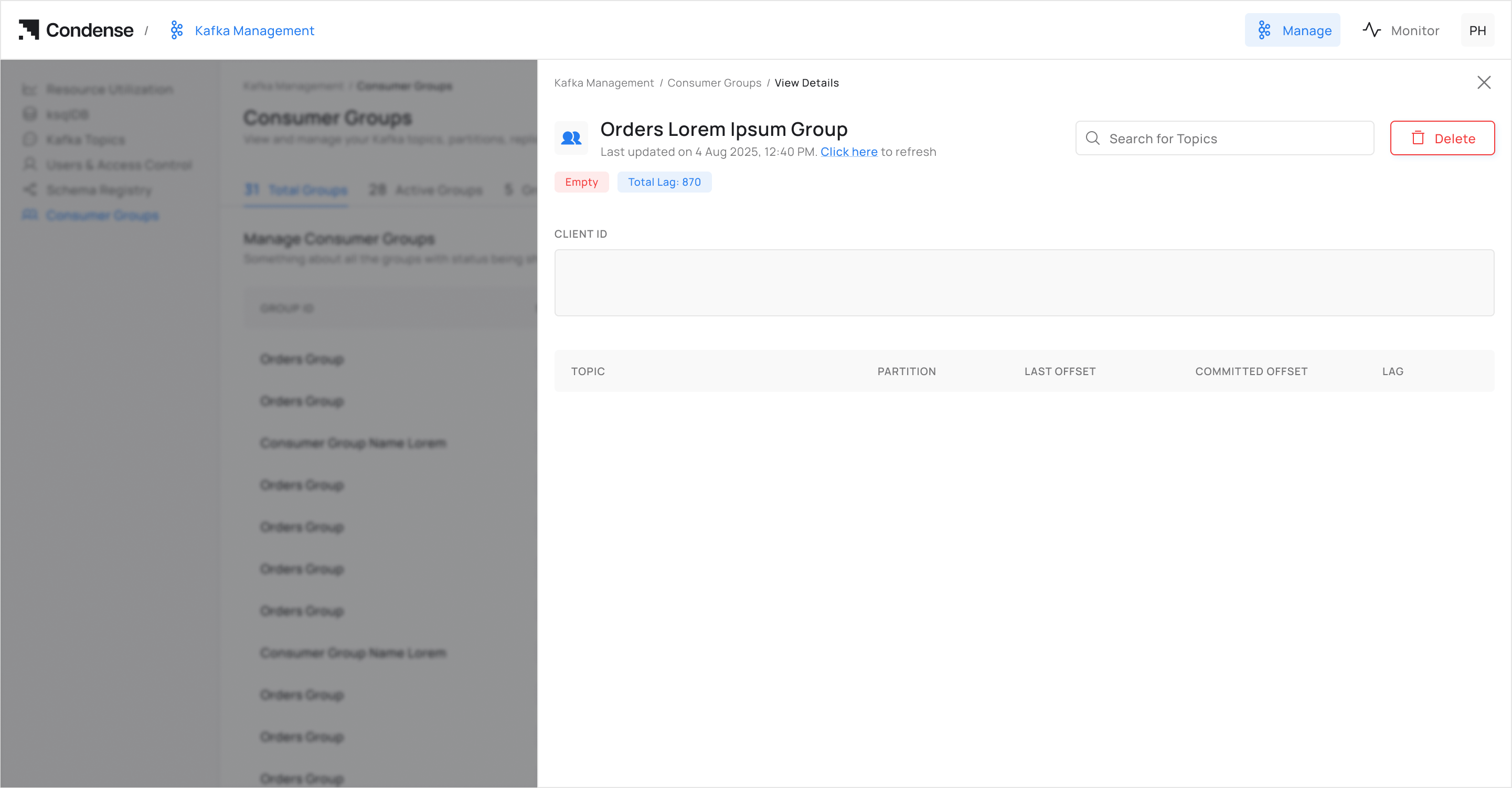
 The details page provides partition-level information for every subscribed topic, including:
| Field | Description |
| ---------------- | -------------------------------------------------------------- |
| Topic | Kafka topic being consumed. |
| Partition | Topic partition number. |
| Last Offset | Latest available offset in the partition. |
| Committed Offset | Latest offset committed by the consumer group. |
| Lag | Difference between the latest offset and the committed offset. |
This information helps administrators monitor consumer progress and identify message processing delays.
## Consumer Lag
Consumer Lag represents the number of messages that have not yet been processed by a consumer group.
A low lag generally indicates that consumers are processing messages efficiently, while a consistently increasing lag may indicate slower processing or consumer performance issues.
Review lag periodically to ensure applications continue processing data as expected.
## Delete a Consumer Group
Consumer Groups can be removed directly from the Kafka Management interface.
To delete a consumer group:
1. Locate the required consumer group.
2. Click **Delete**.
3. Review the confirmation dialog.
4. Confirm the deletion.
The details page provides partition-level information for every subscribed topic, including:
| Field | Description |
| ---------------- | -------------------------------------------------------------- |
| Topic | Kafka topic being consumed. |
| Partition | Topic partition number. |
| Last Offset | Latest available offset in the partition. |
| Committed Offset | Latest offset committed by the consumer group. |
| Lag | Difference between the latest offset and the committed offset. |
This information helps administrators monitor consumer progress and identify message processing delays.
## Consumer Lag
Consumer Lag represents the number of messages that have not yet been processed by a consumer group.
A low lag generally indicates that consumers are processing messages efficiently, while a consistently increasing lag may indicate slower processing or consumer performance issues.
Review lag periodically to ensure applications continue processing data as expected.
## Delete a Consumer Group
Consumer Groups can be removed directly from the Kafka Management interface.
To delete a consumer group:
1. Locate the required consumer group.
2. Click **Delete**.
3. Review the confirmation dialog.
4. Confirm the deletion.
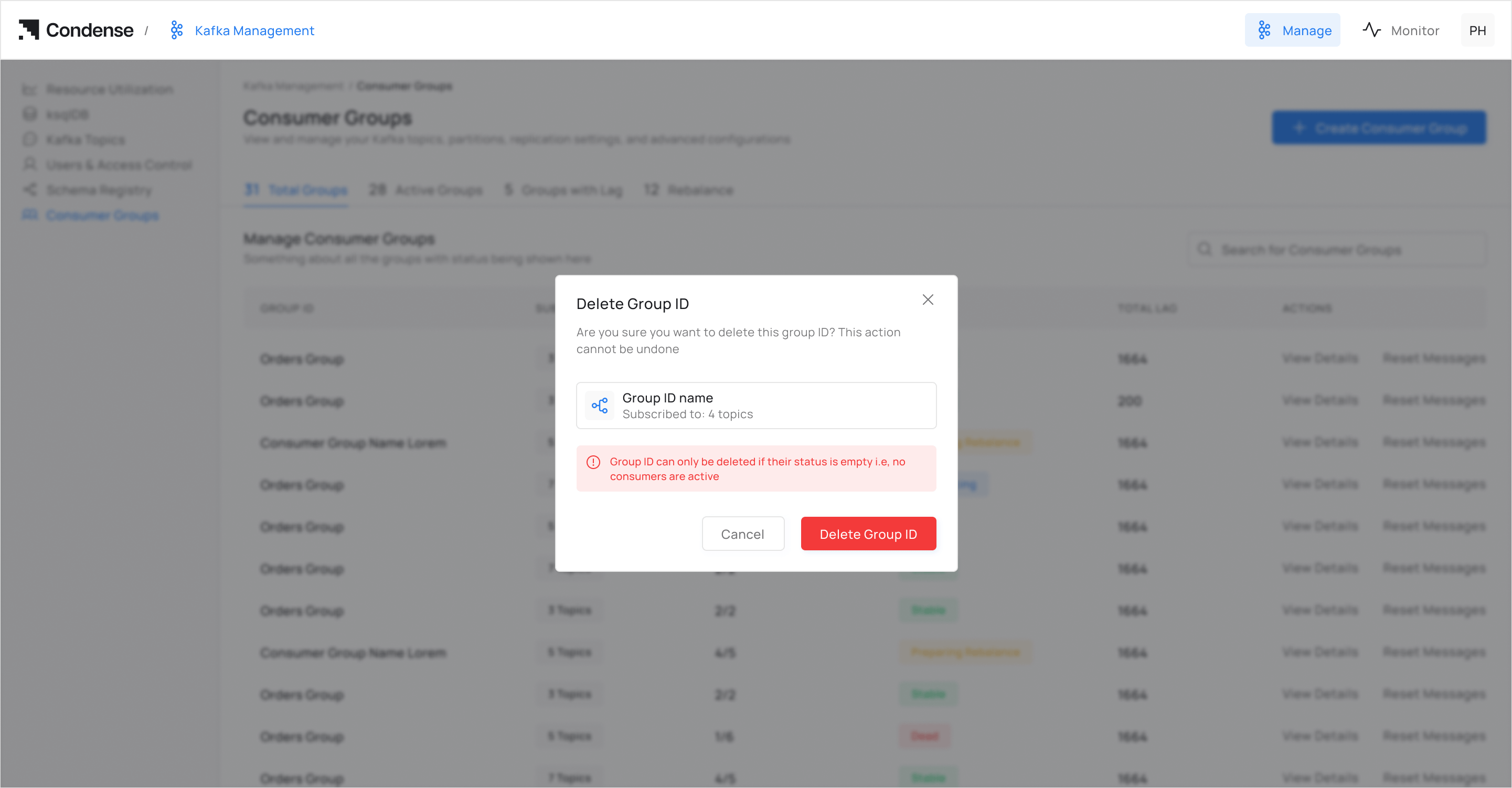 Deleting a consumer group permanently removes its metadata from the Kafka cluster. Ensure the consumer group is no longer required before confirming this action.
## Empty Consumer Groups
A consumer group may not display any topic or partition information if it has not yet started consuming messages or currently has no active subscriptions.
Deleting a consumer group permanently removes its metadata from the Kafka cluster. Ensure the consumer group is no longer required before confirming this action.
## Empty Consumer Groups
A consumer group may not display any topic or partition information if it has not yet started consuming messages or currently has no active subscriptions.
 ## Best Practices
* Regularly monitor consumer lag to identify processing bottlenecks.
* Remove obsolete consumer groups that are no longer required.
* Review consumer group activity before deleting a group.
* Verify consumer status after deploying new consumer applications.
* Monitor consumer groups as part of routine Kafka cluster health checks.
## Related Documentation
* Kafka Topics
* Kafka Connect
* Kafka Administration
* Securing Kafka
## Best Practices
* Regularly monitor consumer lag to identify processing bottlenecks.
* Remove obsolete consumer groups that are no longer required.
* Review consumer group activity before deleting a group.
* Verify consumer status after deploying new consumer applications.
* Monitor consumer groups as part of routine Kafka cluster health checks.
## Related Documentation
* Kafka Topics
* Kafka Connect
* Kafka Administration
* Securing Kafka