

What is the same everywhere
- Passwords, secrets, private keys and tokens are masked. Use the eye icon to show what you typed.
- Certificates, keys and credential files can be pasted or uploaded. Use the Paste Content and Upload File switch. A file larger than 12 MB is refused.
- Fields marked with an asterisk are required.
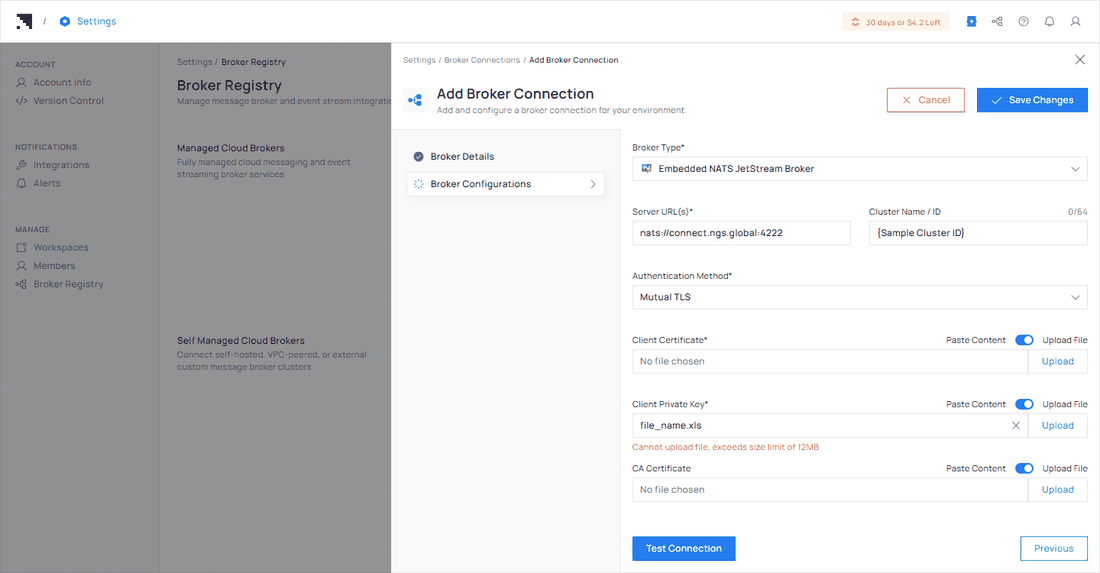
Mutual TLS. A file over the size limit is rejected, with a message under the field.
Broker by broker
NATS: Embedded NATS JetStream Broker and NATS & JetStream Broker
NATS: Embedded NATS JetStream Broker and NATS & JetStream Broker
- Server URL(s) (required): one or more addresses, for example
nats://connect.ngs.global:4222. - Cluster Name / ID (optional), up to 64 characters.
- User Credentials: the NATS credentials content, which holds the JWT and the NKey seed. Paste it or upload the file.
- NKey: the NATS seed.
- Token: an authentication token.
- Username & Password.
- Mutual TLS: a client certificate and a client private key (both required), and a CA certificate (optional).
Condense Kafka Broker and Apache Kafka (self managed)
Condense Kafka Broker and Apache Kafka (self managed)
- Bootstrap servers (required):
host:port, separated by commas for several. - Security protocol: PLAINTEXT, SSL, SASL_PLAINTEXT or SASL_SSL.
- SASL mechanism when the protocol uses SASL: PLAIN, SCRAM-SHA-256, SCRAM-SHA-512, GSSAPI (Kerberos) or OAUTHBEARER.
- TLS: a CA certificate, and optionally a client certificate with its key and key password. A switch skips certificate verification. Use it only for testing, because it removes a safety check.
- PLAIN or SCRAM: a SASL username and password.
- Kerberos: principal, realm, a keytab file, an optional
krb5.conf, and the service name (defaultkafka). - OAUTHBEARER: token endpoint URL, client ID, client secret and an optional scope.
- Schema Registry (optional): its URL, and how to sign in to it: none, basic (username and password) or a bearer token.
Confluent Cloud
Confluent Cloud
- Bootstrap server URL (required): for example
pkc-abcd1.us-east-2.aws.confluent.cloud:9092.
- API Key and Secret: the Confluent API key (16 characters) and secret (32 to 64 characters).
- OAuth 2.0 / OIDC: token endpoint URL (https), client ID, client secret and an optional scope.